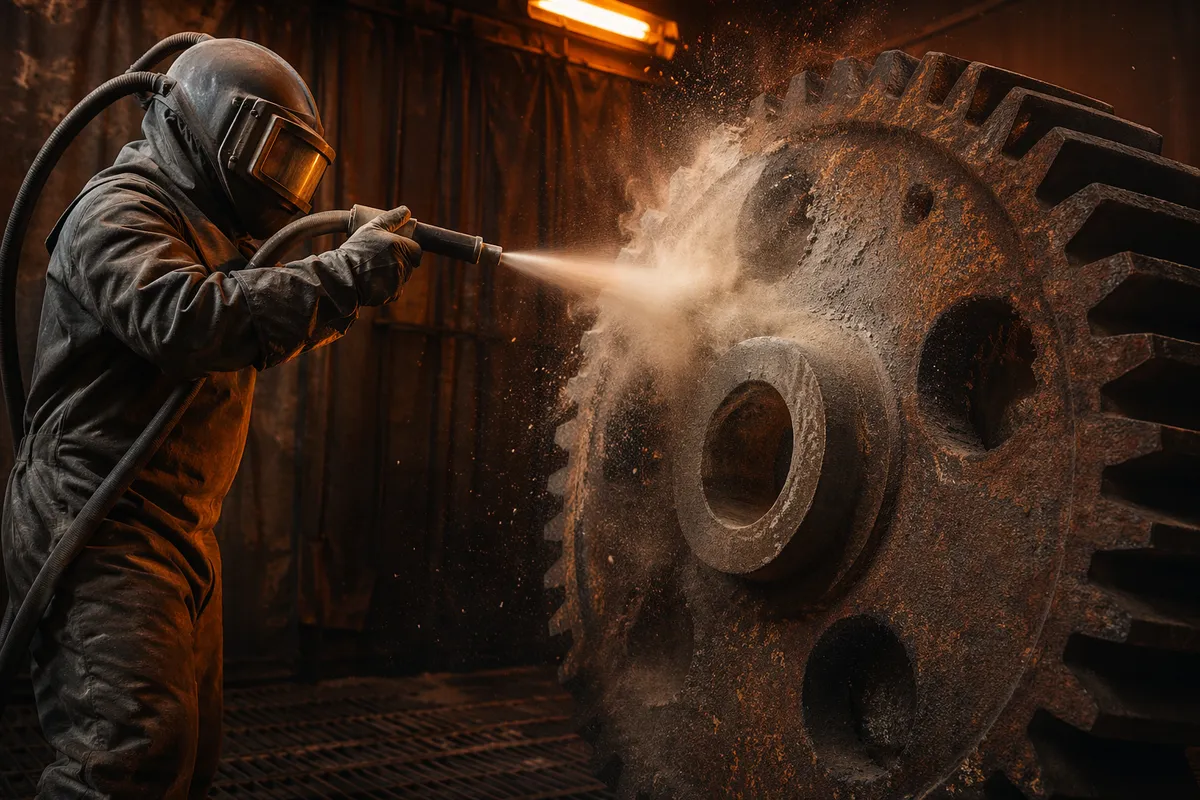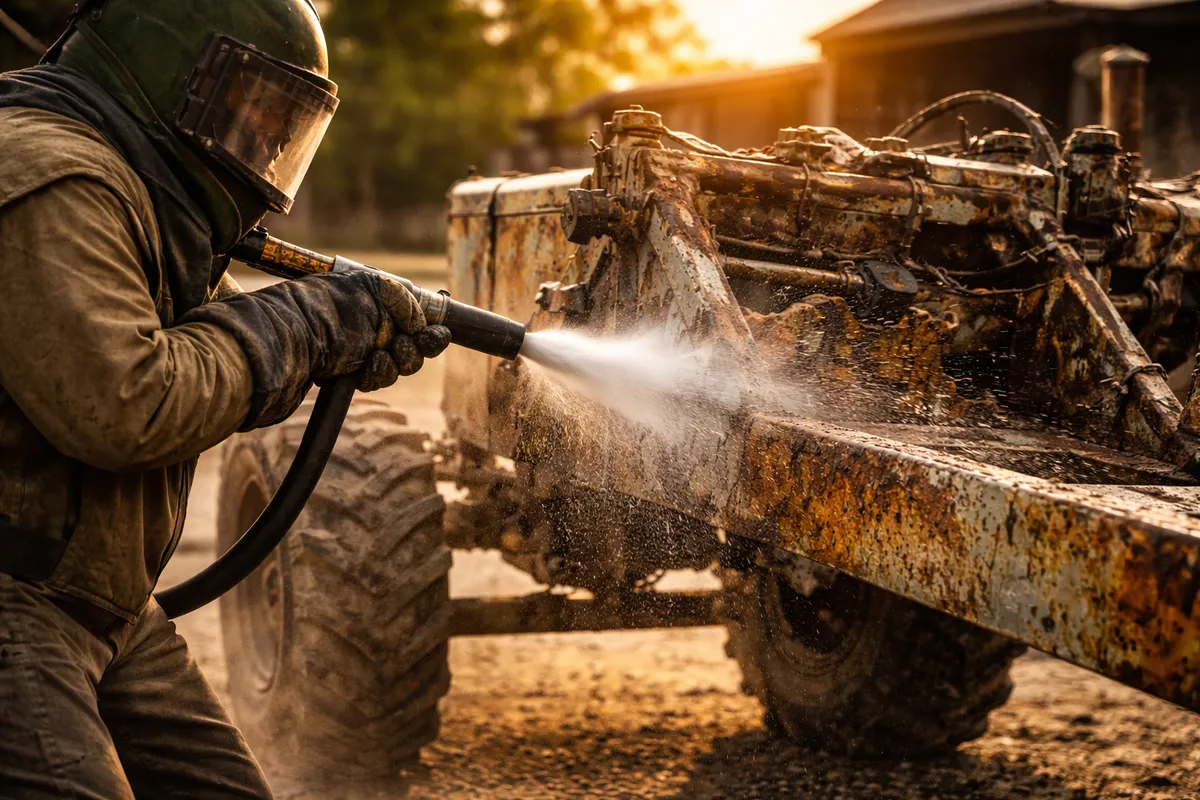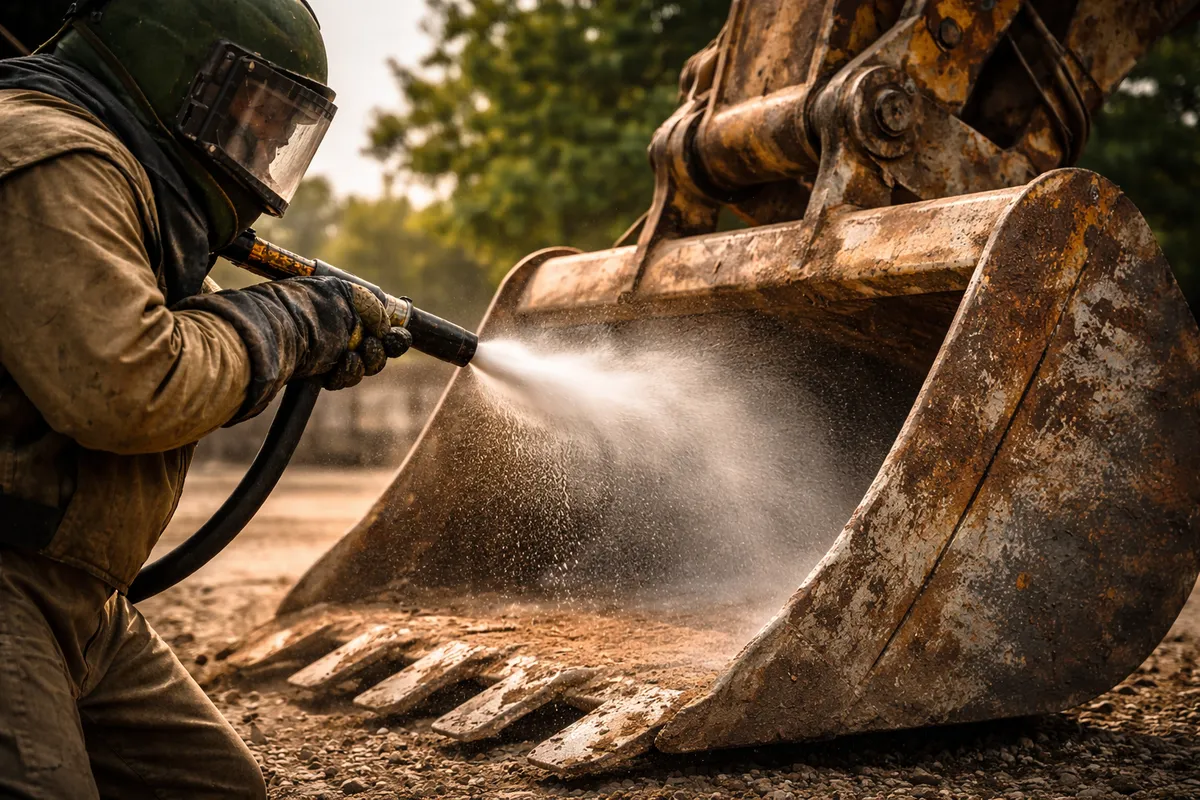
Excavators, dozers, loaders, and tractors are some of the most forgiving steel a blaster can work on, and some of the most expensive to get wrong. The frames are thick, but the machines are covered in hydraulic rods, seals, bearings, glass, and wiring that abrasive will ruin in seconds. The media you choose affects production speed, dust, profile, cleanup, and what ends up in the waste stream.
This guide compares the three abrasives most often considered for heavy equipment: coal slag, crushed glass, and garnet, with steel grit as a fourth option for recovery systems. It uses published manufacturer data where it exists and says so where field results will vary. There is no single best media for every machine; the right choice depends on the coating going on, the coating coming off, and where the work is done.
What Each Media Is
Coal slag. A glassy byproduct of coal-fired power generation, crushed and screened into blasting grades. It is angular, cuts fast, and is widely available. Black Beauty is a well-known coal slag brand. Free silica content and dust behavior vary by product, so check the safety data sheet for the specific slag you buy. Coal slag is expendable: it breaks down on impact and is generally used once.
Crushed glass. Recycled glass crushed into angular grades. It is amorphous rather than crystalline, and manufacturers typically state free silica below 1%. It is light, cuts cleanly, leaves a bright surface, and is also generally used once in open-air work.
Garnet. A natural mineral abrasive that is hard, dense, and angular. Premium grades are marketed as low dust and recyclable in suitable recovery systems. One supplier states that its blasting garnet contains less than 0.1% respirable crystalline silica and meets SSPC-AB 1, the AMPP/SSPC specification for mineral and slag abrasives (BARTON Adirondack garnet).
Steel grit. Angular hardened steel particles. It is the most durable of the group and is normally used in blast rooms or with vacuum recovery, where it can be recycled many times. It is rarely practical for open-air field work because recovering it outdoors is difficult.
Published Profile Data: What the Charts Actually Say
Profile is the depth of the anchor pattern the abrasive cuts into the steel. Coating data sheets usually specify a range, and the abrasive grade is one of the main ways to hit it. One manufacturer publishes ranges for both its coal slag and crushed glass products, measured under the same controlled conditions: 100 psi at the nozzle, 18 inches standoff, a 3/8-inch long venturi nozzle, on new 1/8-inch A36 steel (Black Beauty abrasive FAQ).
| Product type | Grade (mesh) | Minimum nozzle | Published profile |
|---|---|---|---|
| Coal slag | X Fine (30/60) | 1/8 in. | 1.0 to 2.6 mils |
| Coal slag | Fine (20/40) | 3/16 in. | 2.0 to 3.5 mils |
| Coal slag | Medium (12/40) | 1/4 in. | 3.0 to 4.8 mils |
| Crushed glass | X Fine (70) | 1/8 in. | 0.5 to 1.5 mils |
| Crushed glass | Fine (30/70) | 3/16 in. | 1.5 to 3.0 mils |
| Crushed glass | Medium/Fine (20/40) | 1/4 in. | 2.0 to 3.5 mils |
| Crushed glass | Medium (12/30) | 1/4 in. | 2.8 to 4.0 mils |
Two takeaways. First, both media can reach the 2 to 4 mil range most equipment coatings ask for, so profile alone rarely decides between them. Second, the manufacturer notes that field results will vary from controlled cabinet results. Old steel with pitting, mill scale, or prior profile will not measure like new plate. Profile has to be checked on the actual machine.
For garnet and steel grit, use the supplier's grade chart for the specific product and confirm with replica tape or a profile gauge.
Side-by-Side Comparison
| Factor | Coal slag | Crushed glass | Garnet | Steel grit |
|---|---|---|---|---|
| Cutting speed | Fast | Fast | Fast, consistent | Fast, very consistent |
| Recyclable in field work | Generally no | Generally no | Possible with recovery equipment | Needs a recovery system |
| Relative density | Moderate | Lightest | High | Highest |
| Free silica (per makers) | Varies by product; check the SDS | Under 1% for one maker's glass (Black Beauty FAQ) | Under 0.1% RCS for one premium grade | None (metallic) |
| Surface appearance | Darker, can leave embedment | Bright, clean | Clean, uniform | Uniform, depends on hardness |
| Best fit | Open-air production work | Open-air work, lighter coatings, visible-finish jobs | Precise profile specs, recovery systems | Blast rooms, shop production |
"Low silica" does not mean "no hazard." The coating being removed and the dust generated by the media still need to be controlled.
Health and Exposure: What the Rules Require
OSHA's construction silica standard sets a permissible exposure limit of 50 micrograms of respirable crystalline silica per cubic meter of air as an 8-hour time-weighted average, with an action level of 25. Employers must assess exposure for workers expected to be at or above the action level, and abrasive blasting must also comply with the ventilation standard where the blasting agent or the substrate contains crystalline silica (OSHA 1926.1153). That substrate point matters: blasting concrete, masonry, or soil-caked equipment generates silica dust regardless of which media you use. Our masonry restoration guide covers the substrate side of that problem.
Beryllium is the second issue. OSHA states that slags, garnet, silica sand, and crushed glass may contain trace amounts of beryllium, and lists abrasive blasters and pot tenders among construction and shipyard workers with potential exposure (OSHA beryllium overview). The practical response is the same for every mineral media: read the safety data sheet, use a supplied-air blast hood, and keep helpers and bystanders out of the dust cloud.
Old equipment paint is a third issue. Some older industrial coatings contain lead or chromate pigments. Test unknown coatings before blasting so containment, worker protection, and disposal can be planned instead of discovered.
Disposal: Where the "Cheap" Media Gets Expensive
Spent abrasive is mostly media, but it carries whatever came off the machine. If the coating contained lead, the debris may be a hazardous waste. Under the federal toxicity characteristic, waste that leaches lead at or above 5.0 mg/L in the TCLP test carries waste code D008 (40 CFR 261.24). Testing a representative sample of spent abrasive before disposal is the only way to know.
Media choice affects volume. Expendable media generates more waste per square foot than recyclable media, and heavier media means more tonnage to haul. When comparing media cost, include:
- media consumed per square foot for the target cleanliness and profile;
- containment and ground protection needed for the site;
- cleanup labor;
- testing, transport, and disposal of the spent material;
- masking and repair risk around components that cannot be blasted.
Masking and Protecting Components
Abrasive destroys chrome cylinder rods, seals, and bearings quickly, and media that gets into hydraulic or electrical systems causes problems long after the job. Protection is part of the scope, not an extra.
- Cylinder rods: retract where possible, then wrap exposed chrome with heavy tape and a rigid shield such as split pipe or plywood.
- Hydraulic ports and fittings: cap or plug any open port. Leave pressurized lines connected and protect fittings with tape.
- Pivot pins and bushings: grease seals keep out water, not abrasive. Cover them.
- Glass and cab interior: close the cab, tape gaps, and cover glass with sheeting or protective film.
- Electrical: mask connectors, sensors, harnesses, and data plates.
- Engine compartment: protect air intakes, radiators, and belts. Many owners choose to keep the engine bay out of scope entirely.
- Decals and serial plates: mask anything that identifies the machine.
Step-by-Step Process for a Typical Machine
- Confirm the coating spec. Get the primer and topcoat data sheets and note the required cleanliness grade and profile range.
- Wash and degrease. Remove mud, grease, and oil. Blasting through grease spreads contamination.
- Test the existing coating if lead, chromate, or another hazard is possible.
- Mask and shield using the list above.
- Run a test area. Check removal speed, profile, and any embedment before committing to a media and pressure for the whole machine.
- Blast in sections, top to bottom, so debris falls onto areas not yet cleaned.
- Blow down and vacuum. Remove dust from crevices, frame pockets, and the top of booms where it collects.
- Inspect. Compare against the cleanliness grade and measure profile on several areas. Our tank blasting guide explains the SSPC grades and measurement tools.
- Prime promptly while the steel is clean and dry, following the primer's dew point and recoat requirements.
Troubleshooting
| Problem | Likely cause | Fix |
|---|---|---|
| Profile below spec | Media too fine, low nozzle pressure, worn nozzle | Step up a grade, check pressure at the nozzle, replace the nozzle |
| Profile above spec | Media too coarse or pressure too high | Step down a grade or reduce pressure |
| Dark specks embedded in steel | Embedment, more common with some slags | Switch media or adjust angle; check against the coating's requirements |
| Heavy dust cloud, poor visibility | Media breaking down, wet media, poor ventilation | Check moisture separator, consider lower-dust media, improve air movement |
| Media clumping or surging | Moisture in air supply or media | Drain the compressor and separator, keep bags dry |
| Rust bloom before priming | High humidity or too long between blast and prime | Blast smaller areas and prime sooner; re-blast if bloom appears |
Choosing the Media: Decision Criteria
- Open-air, high-production rust and paint removal with a 2 to 4 mil spec: coal slag or crushed glass. Crushed glass is lighter and leaves a cleaner appearance; coal slag is widely stocked and cuts aggressively.
- Machine headed for a high-performance coating with a tight profile range: garnet, especially if recovery equipment is available.
- Shop-based production work in a blast room: steel grit with recovery.
- Lead or chromate coating confirmed: choose media and containment around disposal volume and worker exposure first, speed second.
- Thin sheet metal on cabs and hoods: drop to finer grades and lower pressure. Our classic car frame guide covers distortion on thin panels, and the soda blasting guide covers gentler options.
FAQ
Is Black Beauty bad for heavy equipment? No. Coal slag is a capable production abrasive. The tradeoffs are expendable use, weight, potential embedment, and the dust and disposal planning every mineral media requires. Crushed glass and garnet are alternatives with different tradeoffs, not universal upgrades.
Is crushed glass safer than coal slag? Crushed glass is commonly sold with free silica under 1%, and slag silica content varies by product, so compare the safety data sheets. Neither media eliminates exposure from the coating being removed or from beryllium traces OSHA notes in some mineral abrasives. Exposure controls are required either way.
Can you blast a machine without removing the hydraulic cylinders? Usually yes, with careful masking and shielding of the rods and fittings. Some owners remove cylinders for rebuild at the same time, which simplifies masking.
What profile does equipment paint need? It depends on the coating system. Many equipment primers specify roughly 1.5 to 4 mils. The data sheet for the product being applied is the controlling document.
Can the work be done on site? Often, if there is room to set up ground protection and containment, and the site allows abrasive blasting. Remote sites also need a communication plan; see our jobsite connectivity guide.
Getting a Quote
Useful details include the machine make and model, which areas are in scope, the current coating and whether it has been tested, the coating system going on, and where the machine will be blasted. Ridgeline provides heavy equipment stripping across Pennsylvania, New York, and New Jersey. Send photos and those details through the quote request page, and we will price the actual scope after review.